Unknown's avatar

About Cathrine McLaren

Suburban Mom turned Mountain Woman, I am redefining myself as a happy, healthy, mindful writer. Step one in my journey is to write every day. and now Mountain Woman trying to redefine herself in rural New Jersey. 8/22 starting a new program of weekly writing prompts to tease out both my history and what I want the next chapter to look like.

Mother’s Day 2012

Happy Mother’s Day to all of you who are a Mother or have one (that covers all of us I think!).

My experience with motherhood has been an ongoing lesson in love and life.  As my children became adults, their insights and opinions have taken me places I never would have gone, intellectually and physically.  There is certainly something unique in seeing the world through another’s eyes when they are so familiar yet separate.

I have learned the lessons of letting go while staying close, supporting without judging, listening when it is time to listen and offering an opinion or advice when asked and not before.  I am blessed with a daughter who is firm and kind in setting her boundaries and made my transition from being strictly a parent to an adult friend of an adult child far easier than it might have been.

My son has one of the most intellectual minds I have known and has challenged me to broaden my reading, my thinking and my concept of what it means to parent a bright child.  With both of them I have grown in different ways and I find Mother’s Day a time to be especially thankful of the opportunity to experience motherhood.  Looking back at the snapshots of memories I can’t help but wonder at the two adults they have become.

And to my Mother, thank you for doing your best with a daughter who was not what you might have expected and is still at times a mystery to you.  And to all the many wonderful mothers in my life; sisters, friends, cousins; again best wishes today and every day.

Looking Beyond

“Being happy doesn’t mean that everything is perfect. It means that you’ve decided to look beyond the imperfections.”

 Starting this daily blog was an exercise in overcoming a perfectionist streak a mile wide and to the bone.  Paralyzed by the idea that I could not do something perfectly, most of my goals were lost to fear.  The list is so long that it defined my life.  In my quest to find the kernel of happiness in every day, I realized that I had to let go of the perfect, because it was never going to happen the way I imagined, and it stood looming over my path to the life I wanted.

It is more than a decision to overlook, to look beyond.  It is letting go, swinging with abandon from the trapeze without a net.    The drive for perfection stems from the need or desire to have total control over outcomes.  Ironically the need to feel in control ends up controlling us.  Because I cannot control the outcome of an airline flight, I have a fear of flying.  Because I needed to control the outcome of every group project, I took on the lion’s share of the work  ensuring it was “perfect”.  Last minute panic before the arrival of guests thinking I must have missed something; these and many more caused me to stop in my tracks.  I didn’t fly, I stopped participating in group projects, I did not entertain.  Did this make me happy?

Freeing myself from this need to control admittedly took a great deal of work to get to the root of it and then to slowly let go of the many threads I held tightly wound.  The deepest fear was “what will people think”?  Decades and decades of life taught me that most people are so wrapped up in themselves they hardly notice; the ones who do and are critical I most likely could not have pleased if there was a “perfect”, and the ones who notice and support, praise, lend a hand, make a joke, are cherished above all else.  And truly, how arrogant of me to think I could control another’s thoughts!

Breaking free of the bonds of perfection has allowed me to explore new ideas, put myself and my thoughts out there for all to see and comment upon.  It has renewed my sense of purpose when it comes to all the things I had given up on because I could not always be the all-star, it has given me permission to keep trying when I slip or fall.  Letting go has added a quality of lightness to my life like no other, and that lightness transforms my attitude to one of joy and celebration.   Now about that flying thing…..

Live the Questions

“Be patient toward all that is unsolved in your heart and try to love the questions themselves. Do not now seek the answers, which cannot be given you because you would not be able to live them. And the point is to live everything. Live the questions”  Rainer Marie Rilke from “Letters to a Young Poet”

How many times have you worried a question to no result?  Thought and thought, turned it this way and that a thousand times and still, nothing.  Is it possible that the answer in the form that you seek does not exist?  Or are the answers right there and as the poet says “you would not be able to live them”?

Oddly, the thing about life is that we never have to find the answer to anything, as taking the next breath, living the next moments happen regardless.  The problem will always resolve itself into a sort of answer, one way or the other.  If the question has been asked, and no answer seems forthcoming, living the question as if it were the answer allows the natural tide of living to carry us in the direction intended for us.

This is different from the world of choices, with which we are most familiar and strive to handle well.  Given the either-or question demands a choice, and careful consideration and balance will generally lead us to the correct decision that suits our morality and temperament best.

The universe of questions though, vary from the miniscule to the sweeping.  Working as a poet, trying to divine the precise word to capture the essence of a thought or emotion, can be a question turned endlessly and must be given over to the subconscious.  Then, seemingly miraculously, the word or phrase leaps to mind unexpectedly.  The sweeping questions, of life, love, and being are ones we are even more reluctant to let go of, and tease and worry them to exhaustion.  While even the subconscious may be unable to offer the absolute answer, each day and each action will be its own answer.  Living the big questions and being open and ready to receive each piece of the answer as it arrives, prevents wasting emotional energy overworking problems without resolution, and clears the way for the solution to become part of the fabric overlaying our existence.  Letting go seems difficult, but in the end the result is the same, life goes on and the choice is to miss it while tangled in the question or live it and let the answers come to us.

Geography

It is easier to build up a child that to repair an adult. ~ Author Unknown

Children will not remember you for the material things you provided but for the feeling that you cherished them. ~ Richard L. Evans

In an interview that is quoted in the Los Angeles Times obituary for “Where the Wild Things Are” author Maurice Sendak he explained why he was able to relate so well to children when he had none.  He replied, “We’ve all passed the same places.  Only I remember the geography, most people forget it.

The recollection of being a child can remind us most intimately of the feelings we had when we were small and powerless.  The memories of being cherished can warm our souls.  Lacking those feelings of being cherished we can still imagine how it might have felt, in order to express that to the children in our lives.  Recalling innocence and wonder allow us to relate as Mr. Sendak did to the youngest among us, and opens that window in our soul to a purer part of ourselves.

Many fight the demons of thoughtless words and actions heaped upon them over a long and painful childhood.  Would anyone choose that legacy for their child?  To leave a child’s simple joyous nature mostly intact is a worthy goal.  Perhaps taking our direction from the Hippocratic Oath, “First do no harm”, is an excellent start to the guidebook of parenthood.

Scanning the shelves of the hundreds of books on parenting, the dominant theme is regulating the child in some way; behavior, diet, sleep patterns; the list is endless and numbing.  What I haven’t found is the geography of childhood, the map of marvels and discovery.  It is assumed that a parent must love their child to buy one or ten of these books, and that is likely so.  But rarely is a parent encouraged to become small again in their hearts and souls to recall the impact of the very bigness of the grown-up world and the ofttimes dramatic consequences of adult words and acts.

Recalling our own geography and using it to chart the course of  parenting, teaching, mentoring and all other interactions with children rewards both the adult and the child.  With careful attention we can raise adults who are not just survivors of their childhood but have the well of feeling cherished to draw upon.

Modeling

“It is difficult to bring people to goodness with lessons, but it is easy to do so by example.” -Seneca

Leading with one’s actions rather than words is powerful and effective.  At the same time it allows for the least resistance when we model behavior for those who are entrusted to us, be they our children, the employees we supervise or the friends we so highly value.  I often marvel at the parents riding bikes with their children, kids with helmets firmly in place, parents, no helmet in sight.  I wonder if this is the style in which the family is lead, “do as I say, not as I do”.  This message is confusing to children and adults alike and leads to ignoring the lesson presented.

Not only do our actions speak to those closest to us but to anyone we contact, even through indirect observation.  Acting with kindness and consideration, even under duress, models an attitude one would want to encourage in others.  The effect may be immediate, influencing the others present in a stressful situation, or it may make an impression on the more distant viewer.  Shouting at someone to calm down is far less effective than exhibiting calm in the presence of the agitated person.

Understanding the impact one’s actions have on others also means that we must take care to be consistent in conduct.  The repetitive nature of learning is disrupted when one’s demeanor and moral acts are selective instead of constant.  Acting as one’s best self without concern or excuse for the situation or associations can not fail to serve one well.

The days are filled with choices in actions, each one an opportunity to teach a life lesson, or to act in a manner that inspires modeling from others.  By carefully selecting the best decision we benefit ourselves, and by reflection, influence more than we realize.

Blaming the Victim (Part 2)

This is based on personal observation and experience rather than any empirical data.  The headlines lure us in….Prevent Breast Cancer with  Six Disease Fighting Foods.  The next headline…Prevent Breast Cancer Avoiding Six Toxic Foods.  Hmm, two foods are on both lists, what now?   Preventing any disease seems like a common sense goal, but prevention not being absolutely possible, it seems that taking steps to reduce the risk of contracting everything from the common cold to cancer is the best one can do.  Even the most diligent is likely to be somewhat confused by the overwhelming and often conflicting information available.

But there you are, with that dreaded cold and flu or worse, a fearsome disease.  And what are you asked by your medical professional?  Have you been careful to wash your hands frequently and use hand sanitizer? (Wait didn’t I read somewhere about the dangers of hand sanitizer?)  The questions for the cancer patients can be even more egregious; dietary habits, pregnancies, breast-feeding, Hormone Replacement Therapy.  Honestly, I don’t think it is the intent to point a finger in most cases.  I would hope that it is either to educate the patient in the case of the cold and flu, or to gather relevent statistical information in the case of cancer.  But sadly there is occasionally the undertone of, “you missed something so here you are”.

I think this may be the medical establishment trying to wrap their minds around the idea that not everything is fully “preventable”.  It is simplistic to think that with the complexity of the human organism and the diseases that attack it with all of their subtle variations and resistances, that one can somehow figure out exactly the right combination to achieve prevention.  Forty thousand new cases of breast cancer are diagnosed annually in the US, that number only adjusting with the population.  With all the information, campaigns to raise money and awareness; if this were a preventable disease, wouldn’t something change, even slightly?  There are so many variables with health and illness that it will never be something as simple as following a laundry list and you will be immune.

The worst offenders are the companies that make billions selling supplements, diet plans, books, and more to further push us into the belief that if we do all the “right” things we will be safe.  Recently I heard an ad for a supplement to “protect your eye health”.  It went on to say in fairly straightforward terms that acting now was imperative, your eyesight is at grave risk and you don’t even know it!  Yikes! I’m on it.

There is a  fine line between taking responsibility for health, personal safety and all other aspects of one’s life, and being found at fault when all the best efforts fail us.  To know that there is more than just one’s actions at work, that the other half of the equation is the action of nature, we all die; or the actions of individuals who have less that other’s best interests in mind gives some balance to the argument that each of us is fully responsible for every outcome.

Striving for a best result without obsessing, recognizing that how one handles the end result is a piece of the intricate puzzle of heath, and refusing to be painted as either a victim or one who deserves blame should be enough.  For those who insist on pinning an illness or disease on some overlooked or conflicting recommendations, their motives must be viewed as suspect at best and undermining and cruel at worst.

Take responsibility, but do not take blame.  For some there is a need to find fault.  That “fault” then provides some sense of security and immunity for themselves.  But none of us is fully secure, completely immune.  Approach anyone in your life dealing with any illness, even if it may be directly linked to a behavior, with  a kind and gentle understanding.  We all stumble, we all fail, and hopefully we continue to try to do our best and handle the outcome with grace.
Blaming the Victim

Sadly, in a university city nearest me there has been an ongoing scandal revolving around the handling of multiple sexual assaults and rapes, both on campus and off.  The part that has left certain segments of the community appalled and has become fodder for national commentary, is that it seems law enforcement and school officials deem it more prudent to tell the victims what they should have done or not done, while the perpetrators are hustled out of the country in one case, or carefully hidden from pubic scrutiny either by discouraging the victims from reporting the assault or closing ranks in a hugely popular football program.  The U.S. Department of Justice is now looking at both the university and all aspects of the law enforcement process both on and off campus.  In response to the investigation the local authorities have dug in and pointed their fingers at girls who in their opinion walked home too late, failed to watch their drinks  every moment (date rape drugs have played a part in several instances), let their guard down in one way or another.

Not only does this feel like we have fallen back a half-century; never demanding accountability from the attackers and heaping blame on the victim; but it has fostered an atmosphere of fear and distrust on campus and off.  Why is it so easy to blame the victim?

When one has been victimized, the injured party is left vulnerable and often retreats into various forms of denial and self-protection.  The attacker falls back on their bravado and support of the environment that allows this behavior.  This is bullying taken to its most extreme.  The most helpless are often the least protected, and being aware of the cultural acceptance of brutal acts, leaves them feeling as if they have no shelter or protection.  The only way to continue this culture is pointing a finger at the weakest, while guarding and defending the bully.

Demanding accountability when one holds a position of authority, especially when that stance goes against the tide of public opinion, requires backbone and tenacity. That seems to be in short supply.   The lone public figure who did not scramble to prove that they were in the right and the perception of victim hostility was wrong, has taken enormous heat in the community, and is likely to continue to do so.  It is also interesting that while he made headlines with firings in the athletic department of the university and his programs to call attention to this despicable situation have received a fair share of press coverage; the perception continues that the risk of reporting is too great and the risk of punishment insignificant.  Taking some responsibility for continuing to foster a dated and harmful attitude is woefully lacking in the rest of the public discourse.

What we see instead is scrambling to appear that the situation is under control.  Yesterday’s local paper went so far as to devote as many column-inches to the economic impact to tourism as it did to the federal investigation.  The response by the business community which has worked hard to create a vacation destination campaign?  You got it, blame the victims.  Assuring the people they are hoping to attract to the “Garden City” that these are just careless drunken college girls and that we do not in fact have a “real” problem is the word they are trying to get out.  Apparently we do have a “real” problem and that is that this city is mired in the middle of the last century and fails to grasp that this attitude reflects at least as poorly on the town and university as the problem of sexual assault does.  A significant number of those tourist dollars they are trying to attract come from families whose children attend the university.  It seems that a little assurance that there is some effort to rein in this aggressive behavior would go further than pointing at the brutalized college student and saying that it was their risky or inattentive acts that are at the root of this.

There is a line between taking responsibility for placing oneself at risk and shouldering the blame when the risk results in assault.  The attacker carries the larger part of this responsibility and until we demand accountability the victim will continue to take the blame.

Tomorrow – Blaming the Victim Part 2, How the Heath Care Industry Blames the Victim

Perspective

“To raise new questions, new possibilities, to regard old problems from a new angle, requires creative imagination and marks real advance in science.”
Albert Einstein

It could be added that it marks real advancement in all areas of life.  The point of this blog has always been to do just those three things, raise questions and possibilities and especially to regard old problems from a new angle.

It is a lifelong habit, looking at everything from the most mundane daily tasks to the big questions of life and trying to get a different take on it.  Perhaps that is where my love of organization comes in, when putting items in order it causes me to examine each and understand its purpose, then decide the most logical place to keep it.  In spending time thinking about the use for a particular tool or utensil, I am often inspired to think about it in a completely different way.

Taking the large questions of happiness, love, selflessness, hope, trust, honesty and turning each slightly to gain a different perspective has been far more challenging.   The process of then attempting to articulate these sometimes oddly angled thoughts is demanding.  Not only does it require creative imagination as Einstein said, I believe it also fosters further growth of creative imagination.  To take a multi-faceted object like happiness in one’s hand and turn it about, over and over observing the light refracting while attempting to peer into its core is as inspiring as it is complex.

I began today’s search for a spark within the topic of change when I stumbled upon the above quote.  Even though it does not contain the word as most others do, it does not even address the topic directly; yet it is the essence of change.  Questioning, examining, applying creative thought, causes the internal adjustments that jump-start our growth.  The more open the approach, the more likely the opportunity for brilliant inspiration will present itself.  To push on to greater thoughts, bigger ideas, life altering contemplations we create real advancement in ourselves.

Holding Love Close

“Never cease loving a person, and never give up hope for him, for even the prodigal son who had fallen most low, could still be saved; the bitterest enemy and also he who was your friend could again be your friend; love that has grown cold can kindle”
Soren Kierkegaard

Sometimes the people we love fall away from us.  Their choices, their direction may take them places we choose not to follow.  Love is possibly irrational or unhealthy; who we love and why we love them is a puzzle that is often left unfinished on the table with pieces missing.  Love is the container of hope.  It is a struggle at times to hold out hope for the rehabilitation of one who has harmed or rejected us.  Keeping that person close may not be a good choice or even possible.  What is possible is to hold that love in our hearts.  We can allow the positiveness we exude to travel silently and in stealth to the recipient.

Giving up on love, losing hope, harms the spirit.  Keeping the careful balance of holding out hope for one who is estranged from us without allowing it to cause harm is risky.  Even when we are intimately affected by the pain inflicted by another, losing trust in the potential for change causes that loss in oneself as well.  Perhaps what is best to cling to is not the love of a particular individual, but the belief that anyone can change, anyone can shift a behavior to a positive direction, trusting in the potential for growth in each of us.

It may not even be desirable to rekindle a friendship that has gone sour, but the love does not flee our hearts in direct proportion to the harm.  Some remains to remind us of the good in the person, and the hope remains to give us peace.

Cherish Your Cheerleaders

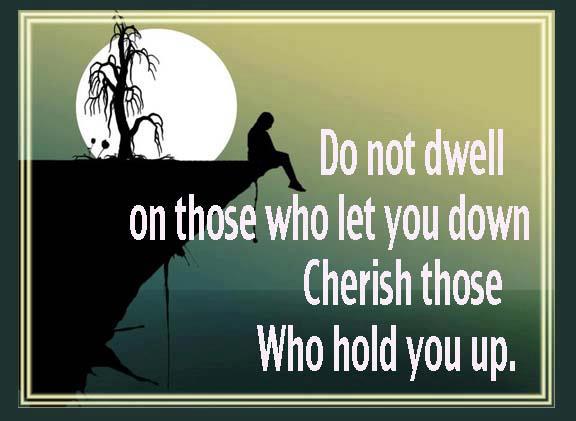
Whether it is coincidence or that our realities are spun so closely together that overlapping is inevitable, it is not unusual that the inspirations for my daily writing come from more than one direction on the same topic.  Today is a stunning example.  I came home and began opening my snail mail while I turned on the computer to check my email.  On Facebook was the above post, in the mail was a card from my sweet daughter, thanking me for being her cheerleader and telling me with much love that she is mine.

Propping each other up is the greatest gift we can give to each other.  We all need to hear from time to time that we are special in the eyes of another, that we are appreciated for who we are and what we do.  Dwelling on the negative, the let downs, the heartaches, can consume and steal time from the uplifting and motivating.  While dwelling on the puzzle of someone who has let you down may seem to demand a solution, generally there is none, and it only serves to reinforce the sadness and self-doubt.  Being let down can literally mean pinned to the ground unable to take even the smallest steps to grow and develop when crushed by the failure of support.

Focusing on the positive by becoming a cheerleader for those closest to you not only helps to hold them up but gives your heart a dose of joy from their response.  Support not only helps through a difficult time or gives one a good feeling and a smile; it can encourage one to expand horizons, to soar to greater heights.  The champions in our lives who offer  themselves as pillars to build upon are among our most valuable assets.  Acknowledging the gift our cheerleaders are to our inner wealth and cherishing all that they mean to us is a reminder to each one of the absolute worth of kind words and generous thoughts.  To grow inwardly one must embrace and reciprocate the outward expressions of love and hope.